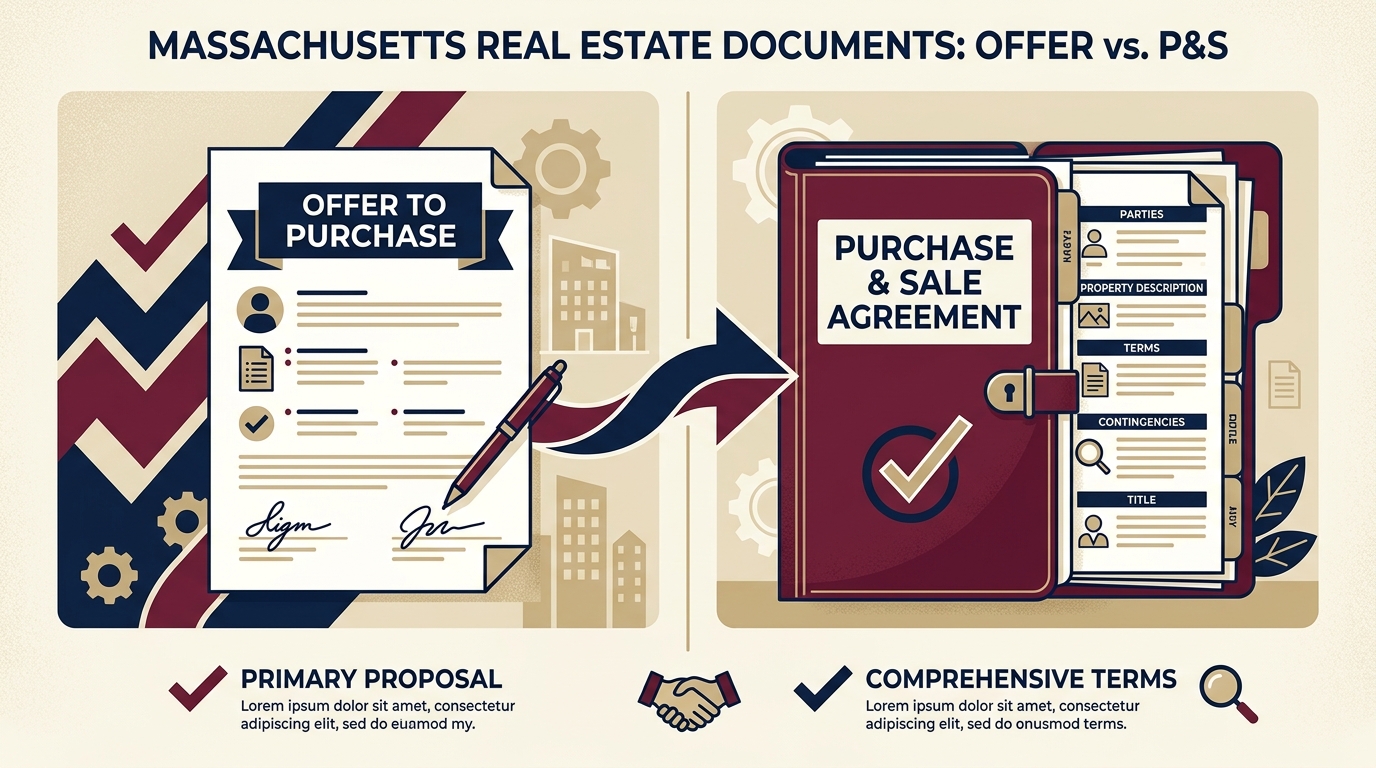
Offer to Purchase vs. Purchase and Sale Agreement in Massachusetts: What’s the Difference?
In an offer to purchase vs purchase and sale MA comparison, the most important point is that neither document should be treated casually. An accepted Offer to Purchase can be legally binding and often establishes the framework for the transaction. The later Purchase and Sale Agreement, often called the P&S, is generally the more detailed contract that governs how the sale moves toward closing.
For buyers, sellers, agents, and lenders, understanding the distinction early can help prevent avoidable disputes, missed deadlines, and unexpected risks. Fitzgerald Law Offices helps clients throughout Massachusetts, including Hingham and the South Shore, review and negotiate real estate agreements before a signature creates obligations.
What Is an Offer to Purchase?
An Offer to Purchase is typically the first written agreement between a prospective buyer and seller after a property has been marketed or discussed. It commonly identifies the property, names the parties, states the proposed purchase price, and sets out the basic business terms of the deal.
Although people sometimes describe an offer as a preliminary step, an accepted Offer to Purchase may be legally binding in Massachusetts. Whether, and to what extent, it is enforceable depends on the language used, the facts of the transaction, and the parties’ intent. The expectation that a more comprehensive P&S will follow does not automatically make the accepted offer nonbinding.
For that reason, buyers and sellers should read an offer as a contract with real consequences—not simply as an expression of interest.
Offer to Purchase vs Purchase and Sale MA: At a Glance
| Topic | Offer to Purchase | Purchase and Sale Agreement |
|---|---|---|
| Primary role | Sets the initial agreed framework for the proposed sale. | Provides the detailed contract governing the transaction through closing. |
| Timing | Usually signed first, before the P&S is prepared. | Usually signed after the offer is accepted and reviewed. |
| Level of detail | Often concise, but still may contain significant obligations. | Typically more comprehensive and tailored to the property and transaction. |
| Deposits | May identify an initial earnest-money deposit and when it is due. | Often addresses additional deposits, escrow handling, and release conditions. |
| Contingencies | May include basic inspection, financing, or P&S deadlines. | Usually provides fuller contingency procedures, notice requirements, and remedies. |
| Legal review | Should be reviewed promptly because acceptance can create obligations. | Commonly negotiated and finalized by counsel for the parties. |
Core Terms Commonly Found in an Offer
Offer forms vary by transaction, brokerage, and property type. Still, an Offer to Purchase commonly addresses core terms such as:
- The property address and a description of what is being sold
- The purchase price and method of payment
- The amount, timing, and holder of an initial deposit
- A target date for signing the Purchase and Sale Agreement
- A proposed closing date
- Inspection and financing provisions, if included
- Personal property, fixtures, appliances, or other items intended to remain with the property
- The intended path to a later, more complete P&S
Small wording choices can matter. For example, a buyer who expects a particular appliance, storage area, parking arrangement, or included fixture should not assume the issue will resolve itself later. Similarly, a seller should understand exactly what property and obligations are being offered before accepting.
Why the Purchase and Sale Agreement Is More Detailed
The Purchase and Sale Agreement is usually the central contract for a Massachusetts closing. It expands on the accepted offer and addresses the practical and legal issues that must be resolved before title transfers.
A carefully prepared P&S can include fuller seller representations, title and survey provisions, casualty and risk-of-loss terms, default remedies, closing requirements, and detailed contingency language. It may also address title insurance, municipal matters, escrow arrangements, occupancy, prorations, condominium documents, repair agreements, or property-specific concerns.
For instance, a title search may identify an old lien, easement, probate issue, boundary question, or other item that requires attention. The P&S can establish what the seller must do to deliver marketable title, what happens if a problem cannot be resolved, and how the parties will proceed if more time is needed. Fitzgerald Law Offices routinely handles title review, title-curative work, and South Shore title and escrow coordination as part of a thoughtful closing process.
Contingencies and Deadlines Deserve Close Attention
Inspection, financing, appraisal, sale-of-existing-home, septic, and condominium-document issues are often addressed through contingencies or related provisions. The relevant deadline, required notice, and consequence of nonperformance can differ from one agreement to another. There is no single form or timeline that applies identically to every Massachusetts transaction.
Consider a general example: a buyer may have a limited period to conduct an inspection and decide whether to move forward under the terms stated in the agreement. If the buyer wants to seek a credit, request repairs, terminate under a contingency, or preserve another right, the contract may require action by a specific date and in a specified manner. Waiting until the P&S deadline—or assuming an informal conversation is enough—can create unnecessary risk.
The same is true for financing. A buyer should understand the financing terms, deadlines, and documentation requirements before signing. Sellers should understand when a financing contingency may allow a buyer to withdraw and how deposits may be handled in that event.
Common Mistakes Buyers and Sellers Make
One common mistake is treating the Offer to Purchase as an informal placeholder. Once accepted, it may establish enforceable commitments, including deadlines that arrive quickly. Another is assuming that every issue can be fixed in the P&S after the offer is signed.
Other recurring problems include missing an attorney-review opportunity, overlooking an inspection or financing deadline, leaving included property unclear, and failing to address a known title or occupancy issue early. Buyers also may not appreciate how deposit provisions operate, while sellers may underestimate the importance of clearly defining default remedies and closing conditions.
Real estate agents and loan officers play an important role in keeping a transaction moving, but the legal terms should be reviewed by counsel. A Massachusetts real estate attorney can help ensure that the written agreement reflects the actual understanding of the parties.
When to Involve a Massachusetts Real Estate Attorney
The best time to involve counsel is before signing an Offer to Purchase whenever possible. Early review is especially valuable for first-time buyers, cash transactions, estate sales, off-market purchases, investment properties, condominium purchases, properties with known title concerns, and transactions with unusual timing or financing terms.
Counsel can also be particularly important when an inspection reveals significant concerns, the parties are negotiating repair credits, a deposit dispute develops, or the closing depends on resolving a lien or other title issue. For commercial purchases, land transactions, new construction, trusts or LLCs holding property, and transactions involving zoning, permitting, or environmental questions, early legal involvement can help clarify responsibilities before they become costly disputes.
Fitzgerald Law Offices provides buyer and seller representation, purchase and sale drafting and negotiation, residential and commercial closings, lender representation, and title services across Massachusetts. Whether you are working with a Hingham real estate closing attorney or coordinating a transaction elsewhere in the Commonwealth, the goal is the same: identify risks early and create a workable path to closing.
How the Documents Work Together
The Offer to Purchase and P&S are not competing documents; they are usually sequential parts of the same transaction. The offer often captures the deal’s essential business terms and establishes the next steps. The P&S then supplies the detail needed to allocate risk, address due diligence, set closing obligations, and define what happens if the deal does not proceed as planned.
In an offer to purchase vs purchase and sale MA analysis, the practical lesson is simple: review both documents carefully, meet every deadline, and do not rely on assumptions or verbal assurances when a material point should appear in writing.
FAQ
Is an accepted Offer to Purchase legally binding in Massachusetts?
It can be. An accepted offer may be legally binding depending on its terms, the parties’ intent, and the circumstances. Because an anticipated P&S may not erase obligations created by the offer, it is wise to seek legal review before signing.
Does the Purchase and Sale Agreement replace the Offer to Purchase?
The P&S usually becomes the more complete agreement governing the transaction, but the relationship between the documents depends on their wording and the facts. Parties should not assume that an earlier accepted offer has no effect without reviewing the agreements carefully.
How much is the deposit for a Massachusetts home purchase?
Deposit amounts vary. The parties may negotiate an initial deposit with the offer and an additional deposit with the P&S. The agreements should clearly state the amount, due date, escrow holder, and circumstances in which funds may be released.
Can a buyer negotiate after a home inspection?
Possibly. Whether a buyer can request repairs, a credit, a price change, or termination depends on the agreement’s inspection language and deadlines. The seller is not automatically required to agree to a requested change.
Do I need a lawyer before signing an offer in Massachusetts?
Early legal review is strongly advisable because an offer can contain binding terms and short deadlines. An attorney can help a buyer or seller understand the proposed obligations and identify provisions that may need clarification or negotiation.
Talk With Fitzgerald Law Offices Before You Sign
This article is for general information only and is not legal advice. Real estate agreements and deadlines depend on the specific contract, property, and circumstances. If you are a buyer, seller, real estate agent, or lender facing an offer or P&S, contact Fitzgerald Law Offices before signing. Our Massachusetts real estate law team can help you understand the documents, protect your interests, and move toward a well-managed closing.